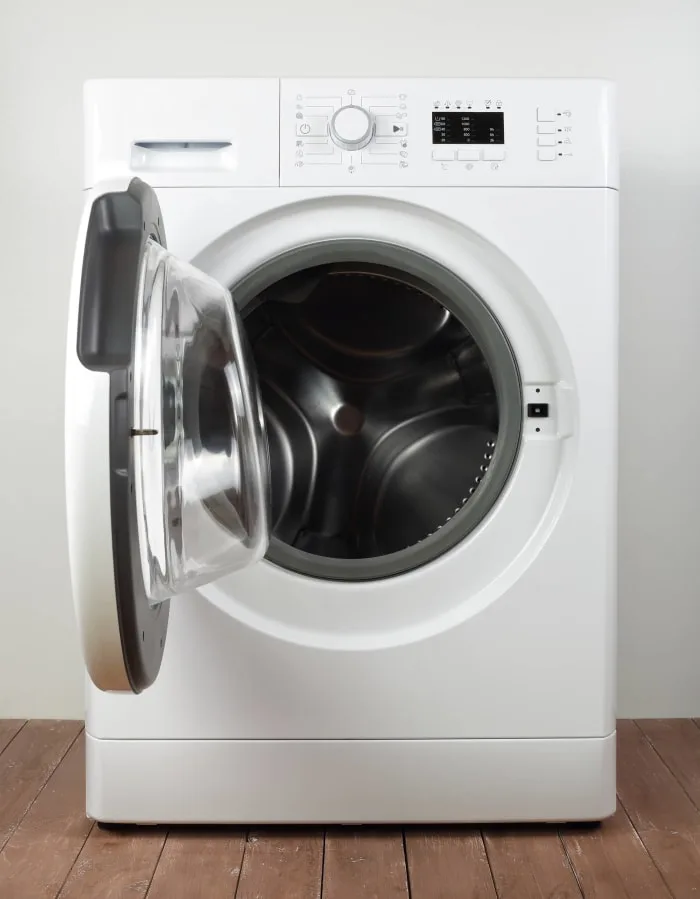
Samsung washer and dryer repair covers door lock and latch faults, drain pump and filter faults, vibration and shaking, heating element replacement on dryers, and drum faults. A local provider checks the machine at your home, finds the faulty part, and repairs it.
Samsung washers are among the machines our providers see most often in North Carolina homes — and the faults are consistent. Samsung washers most often come to us with door lock problems, drain faults, and vibration. Samsung dryers most often come to us with heating faults and drum problems.
Most Samsung machines are front-load or high-efficiency models with large round doors and digital displays.
Their parts — door latches, drain pumps, heating elements, suspension rods — are usually available, and the part is ordered against the exact model number, which is on the rating plate inside the door frame or on the rear panel.
Common Samsung faults at a glance
- Drain pump failure
- Door seal leaks
- Washer will not drain
- Washer will not spin
- HC error code
- Dryer not heating
What goes wrong with Samsung washers most often?
Samsung owners run into the door lock more than any other fault. Until the latch clicks home the machine refuses to start, fill or spin — it simply sits silent. Diagnosis starts at the latch itself: it is a small, inexpensive part and it fails more than anything else on these machines.
If the latch is sound, the fault sits in the wiring or the control board.
When a Samsung washer will not drain, the fault is usually a filter choked with lint and coins, a drain hose bent double, or a pump that has stopped running.
Behind a small flap low on the front sits the pump filter, catching coins, hair and lint before they reach the pump; once it is packed, water has no way out.
Shaking is the third common fault. Samsung front-loaders spin fast, so a machine that is not level, a load bunched to one side, or tired suspension rods will set it walking across the floor. Feet and load are checked first; rods are replaced only if the shaking survives that.
Common Samsung dryer faults
Heat is where Samsung dryers most often fail. The element makes the heat, so a dead element means a cold dryer. Element, thermostat and thermal fuse are tested one after another — swapping parts blindly leaves the fault in place.
Next is a drum that will not turn. On a Samsung front-load dryer that usually means a snapped belt, a seized pulley or a dead motor. The belt links motor to drum, so when it breaks the motor hums and the drum stays put; pulley and motor are checked alongside it.
HC on a Samsung gas dryer means a heating fault, most often the igniter or the gas valve. Heating parts and vent are tested together, since a choked vent can trip the thermal fuse and kill the heat.
What do the error codes on a Samsung machine mean?
Samsung codes narrow the fault fast. Drain code: pump or filter. Door code: latch. Supply code: inlet valve or water supply. HC on a gas dryer: heating.
- Make sure the door is shut and the latch has clicked.
- Look at the display and copy down any code shown.
- Open the pump filter flap and clear out lint and coins.
- Run a short cycle and note where it stops or leaks.
Jot the code down before you reset the machine — it points the provider at the right part. A code that disappears when you reset and comes back next wash is still a genuine fault; it only shows itself under load.
Should I repair or replace my Samsung machine?
A Samsung under eight years old needing a latch, a drain pump or a heating element is usually a repair, not a replacement — parts are easy to find and the machine has years left in it.
The heating element and the drum are the dearer Samsung parts, so a machine that needs both is weighed differently from one that needs a latch alone.
Past twelve years, a dead control board or a worn drum bearing changes the sums. The provider will say plainly if a part has to be ordered, and the provider walks you through the visit before any work begins.
What to tell your provider about your Samsung machine
Start with the Samsung model number — rating plate inside the door frame or on the rear panel — then the fault in your own words. The model number counts for more than the brand: two Samsungs from different years can take different drain pumps, different door locks and different control boards.
Any code on the display — drain, door, or HC on a gas dryer — note it down before you switch the machine off; a reset can wipe it.
Say when the fault started and whether it has happened before. Say whether the machine fills and drains normally, whether the drum turns, and whether the door locks.
Where the water shows matters: door seal, underneath, or at the back. With the leak's location, the model and the code in hand, a provider can turn up carrying the Samsung part most likely to have failed.
For the wider picture, see Samsung washer repair in North Carolina — it covers the main front-load washer repair work our providers do on Samsung machines.