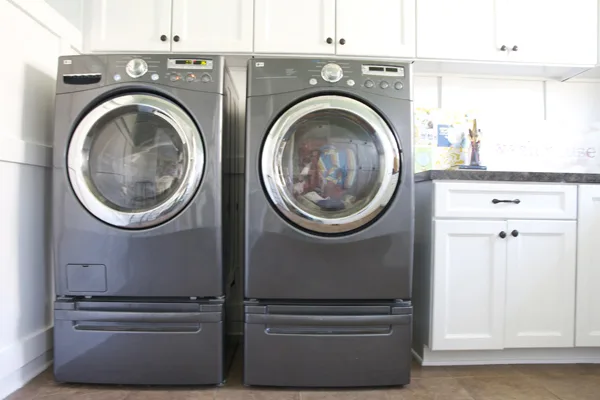
Washer and dryer repair covers both machines as one job: diagnosis and repair of the washer and the dryer together, including stacked units and laundry-room pairs. A local provider checks both machines in a single visit, so the laundry is running again after one appointment.
A laundry room is a pair of machines, not one. The washer washes and the dryer dries, and when one of them fails the laundry stops either way. When both need work, booking them as one job saves a second visit and a second wait.
Stacked pairs are the clearest case. The dryer sits on top of the washer, so reaching the washer means working around the dryer. A provider who services the pair together checks the stack as a unit: the washer's drain and the dryer's vent, the washer's vibration and the dryer's stability.
Why fix both machines in one visit?
The most common pair job is simple: the washer has a fault and the dryer has a fault, and both are fixed in one visit. A washer that will not drain and a dryer that will not heat are two separate faults, fixed by the same provider in the same visit.
- Describe both faults — what each machine does, and when it started.
- The provider runs the washer and watches the fill, wash, drain, and spin.
- The dryer is run and checked for heat, spin, and airflow.
- Faulty parts on either machine are repaired or replaced.
- Both machines are tested together before the visit ends.
One visit also means one diagnosis of the laundry room itself. A dryer that takes too long to dry and a washer that leaves clothes too wet are often the same problem seen twice — the washer is not spinning properly, so the clothes go into the dryer soaking wet.
What is different about stacked washer-dryer pairs?
Stacked pairs save space, and they create their own repair problems. The dryer sits on top of the washer, so the washer cannot be moved without dealing with the dryer first. The pair shakes as a unit, so a washer that is not level makes the dryer unstable too.
Providers who work on stacked pairs check the stacking kit and the brackets that hold the dryer in place, as well as the washer's levelling feet. A loose stack is a safety problem, not just a noise problem.
Vent and drain access is tighter on a stacked pair. The dryer vent runs behind the pair and the washer drain hose runs beside it, so both are checked for kinks and blockages as part of the same visit.
Can a dryer fault make the washer look broken?
A dryer that takes two cycles to dry a load is often blamed on the dryer, when the real fault is the washer. A washer that does not spin properly leaves the clothes soaking wet, and no dryer can dry soaking clothes in one cycle. The dryer is working; the washer is not.
The same confusion runs the other way. A washer that seems to leak can be a dryer vent problem: a blocked vent pushes warm, moist air back into the laundry room, and the moisture condenses on the floor and walls. It looks like a leak, but the washer is dry.
A provider who checks both machines finds the real fault instead of fixing the wrong machine. That is the point of a pair visit: the two machines are tested together, not in isolation.
Which dryer faults are covered in a pair visit?
The dryer faults most often fixed alongside washer work are the dryer not heating, the drum not spinning, a worn belt, a burning smell, and a blocked vent. A dryer that runs cold usually has a dead heating element, a thermostat that has stopped working, or a blown thermal fuse.
A drum that will not turn usually has a snapped belt or a failed motor. A burning smell usually means lint has gathered around the heating element and in the vent, and the vent is cleaned as part of the visit.
The dryer vent is checked in every pair visit, because a blocked vent makes the dryer work harder, take longer, and wear out sooner. A vent that is crushed behind the pair restricts airflow even when it is clean.
How are laundry-room pairs and hookups checked?
A laundry-room pair shares its services: the water supply, the drain, the vent, and the power. The washer uses the water and the drain; the dryer uses the vent and the power. When both machines are serviced together, all four are checked.
Gas dryers add a gas connection to the list. A gas dryer that will not heat may have a faulty igniter or gas valve, and the connection itself is checked as part of the visit. Electric dryers need a sound outlet and breaker.
Providers check the whole laundry room, not just the machine that was reported, because the machines share the same small space and the same services.
What affects the cost of a pair repair?
The cost depends on the faults, not on the number of machines. Two small faults — a washer lid switch and a dryer belt — cost less than one large fault, such as a washer control board or a dryer motor. The visit itself is one visit, so the pair job saves the cost of a second appointment.
Parts are the main factor. Parts for familiar brands usually arrive sooner, and the provider will say if a part will take time to arrive. What the visit covers, and which parts are needed, is set out before the work starts.
For a laundry room where both machines need work, see washer and dryer repair in North Carolina — the same pair service runs in Matthews, NC, where one visit covers both machines together.