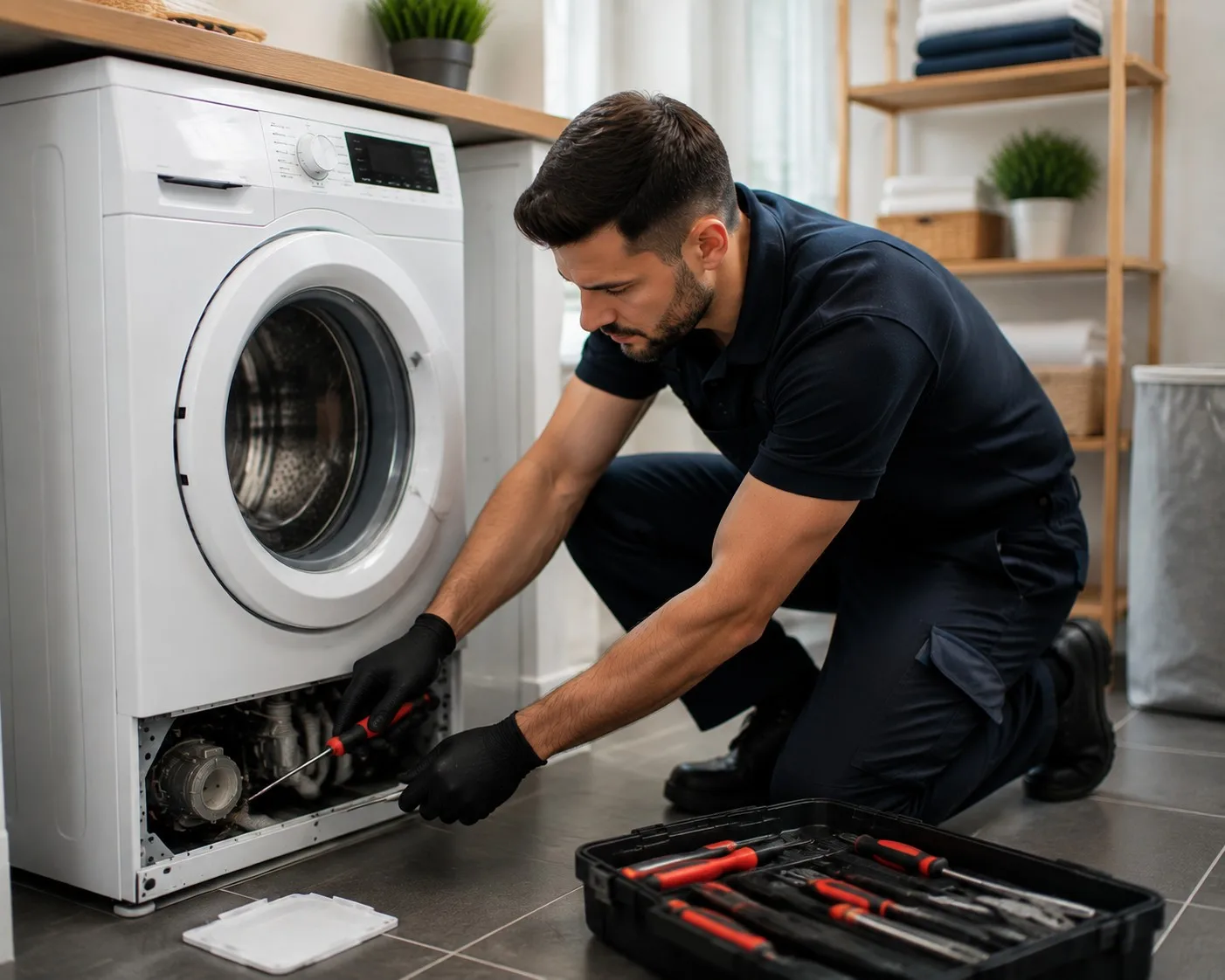
Whirlpool washer and dryer repair covers Duet F11 and FH error codes, lid lock faults, washers with no power, dryers that click but will not start, and idler pulley faults. A provider comes to the house, finds the fault, and fits the replacement part there.
Whirlpool is one of the most common washer brands in North Carolina homes, and the Duet front-load line is the one that turns up most often: large round door, digital display, and a drain pump filter behind a small flap at the front base.
Whirlpool top-loaders are common too, and they fail the way hard-working top-loaders do: lid switches, drive belts, couplings and suspension. Parts are usually easy to find, since Whirlpool is common and its parts fit many models.
Common Whirlpool faults at a glance
- F11 control error
- FH fill error
- Lid lock fault
- No power
- Idler pulley noise
- Drum not turning
What does the F11 error mean on a Whirlpool Duet washer?
F11 on a Whirlpool Duet means a communication fault between the control board and the motor control. The machine usually stops mid-cycle or will not start at all.
Wiring between the boards is checked first — a loose connection throws the same code as a failed board. If the wiring is sound, the motor control or the main board is tested.
Copy F11 down before you reset the machine — a reset can wipe it. A code that disappears on reset and returns next wash is still genuine.
What does the FH code mean on my Whirlpool washer?
FH on a Whirlpool washer means a water inlet fault: the machine fills slowly, or not at all. On a Duet the usual causes are a shut or faulty inlet valve, a bent supply hose, clogged mesh screens, or low water pressure.
On a Duet, FH usually traces to the inlet valve at the back, the mesh screens inside the hose connections, or the supply valves on the wall. The screens catch grit and clog slowly, so the fill gets slower over weeks before FH appears.
FH can also mean siphoning: a drain hose sitting too deep in the standpipe lets water run out as fast as it fills in.
- Check the supply valves are open.
- Check the hose for kinks and the screens for grit.
- Copy the FH code down before resetting.
- Check the drain hose is not too far down the standpipe.
Lid lock and no-power faults
When a Whirlpool will not spin, the lid lock is usually at fault. The lock tells the machine the lid is shut; if it does not engage, the drum stays still. The lock gets a first look — small part, and the fault is often there.
A Whirlpool with no power usually has a power fault: outlet, breaker or control board. Outlet and breaker are checked first, then the board.
A Whirlpool dryer that clicks but will not start usually has a faulty door switch or a failed motor. The switch is tested first: a dryer will not run with the door open, and a failed switch tells it the door is open when it is not.
Idler pulley and drum faults
A Whirlpool dryer that squeaks or thumps usually means the idler pulley or the drum rollers have worn. The pulley keeps the drive belt taut and squeaks when its bearing wears; the rollers carry the drum and thump when they wear.
Replacing pulley and rollers is a proper repair that makes the dryer quiet again; the belt is checked at the same time, since a worn belt and a worn pulley often fail together.
Should I repair or replace my Whirlpool machine?
A Whirlpool under eight years old that needs a lid lock, a drain pump or a drive belt is usually fixed, not replaced — those parts are easy to get and the machine is barely middle-aged.
A Duet showing F11 is weighed differently — the fault may be loose wiring between the boards, not a board itself, so diagnosis comes before any decision.
A Whirlpool past twelve years with a dead control board is a harder call. Parts are usually available — Whirlpool is common and its parts fit many models — but if ordering is needed the provider says so before starting.
What to tell your provider about your Whirlpool machine
Give the provider the brand and model, and the fault as you see it. On a Duet the model number sits on a plate inside the door; on a top-loader it is usually under the lid or on the back. It matters more than the brand alone — two Whirlpools from different years can take different lid locks, different inlet valves and different control boards.
F11 or FH on the display should be written down before the machine is switched off, since a restart clears it.
Say whether the machine fills, whether the drum turns, and whether the lid or door locks.
Where the water shows matters: a Duet leak at the door points to the gasket, water at the back points to the hoses. That, with the model number and the code, means a provider can arrive carrying the Whirlpool part most likely to have failed.
Whirlpool's Duet faults sit in a wider context on Whirlpool washer repair in North Carolina, which also points to front-load washer repair for the door and drain checks.