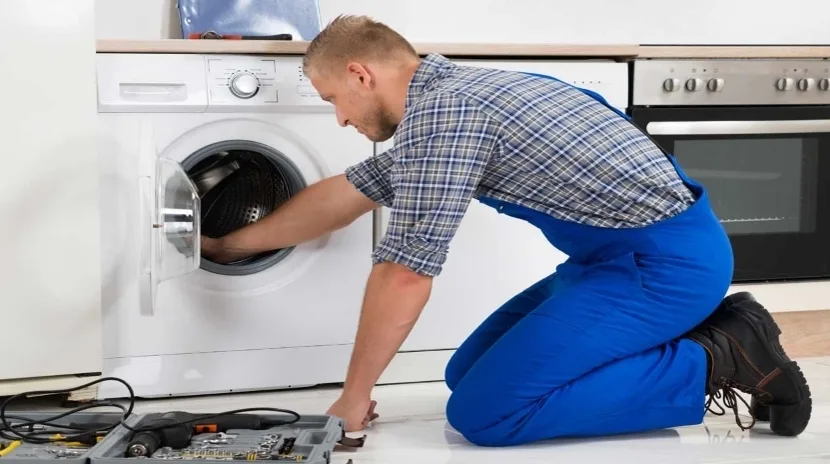
Washing machine repair covers full-machine diagnostics and repair for every type: front-load, top-load, high-efficiency, compact, and stacked machines. A local provider at your home runs the machine through a full cycle, finds the fault, and gives an honest repair-versus-replace answer before any work starts.
People search for washing machine repair when the machine has stopped doing its job and they do not know why. The machine fills but will not drain. It leaks. It shakes. It shows an error code. It does nothing at all. Each of those is a starting point, not a diagnosis — and the diagnosis is the job.
A full-machine diagnosis runs the machine through its whole cycle: fill, wash, drain, spin. The provider watches each stage and notes where it fails, because where it fails points to the part. A machine that fills and washes but will not drain has a drain fault. A machine that drains but will not spin has a drive fault.
How does full-machine diagnostics work?
A diagnosis starts with the fault in your own words, then the machine is run through a cycle and watched. The provider checks the fill first: does the water come in at the right speed, hot and cold both working? Then the wash: does the drum or agitator move? Then the drain: does the water leave, and how fast?
- Describe the fault and any error code on the display.
- Watch the machine through fill, wash, drain, and spin.
- Each stage is matched to its parts: valves, motor, pump, switch.
- The faulty part is tested, not guessed at.
- The repair is explained, with the repair-or-replace answer.
Error codes are read before the machine is opened, because a code narrows the fault to a part. A drain code means the pump or filter. A door code means the latch. A water code means the inlet valve or the supply. The code tells the provider where to look first.
Should I repair or replace — what does the full diagnosis say?
On this page the repair-or-replace answer comes from the whole machine, not from one part in isolation. The diagnosis maps every stage — fill, wash, drain, spin — and the provider weighs the fault against the condition of the rest of the machine. A failed switch on a machine that fills, washes, drains, and spins cleanly is a repair.
A machine that shows wear at several stages is a different answer. A pump fault plus a noisy bearing plus a latch that sticks points to a machine near the end of its life, even if each fault on its own is fixable. The provider says so when the stages add up that way.
Which machine types are covered?
Front-load machines, top-load machines, high-efficiency machines, compact machines, and stacked pairs are all covered. Each type has its own faults: front-load machines have door seals and latches; top-load machines have agitators and lid switches; high-efficiency machines have their own control and sensor faults.
| Machine type | Typical faults | Diagnosis focus |
|---|---|---|
| Front-load | Door seal, door latch, drum bearing | Seal, latch, and spin noise |
| Top-load | Agitator, lid switch, suspension | Agitator movement and spin |
| High-efficiency | Sensors, control board, inlet valve | Error codes and fill stage |
| Compact / stacked | Same parts in a smaller space | Access, levelling, and the pair |
The diagnosis is the same for every type: run the cycle, watch each stage, find the fault. Parts are picked for the exact make and model, so the brand and model number — usually on a label inside the door or on the back of the machine — help the visit go faster.
What do common faults mean?
A machine that will not start usually has a power fault, a door latch fault, or a control board fault. A machine that fills but will not wash usually has a motor or drive fault.
A machine that will not drain usually has a pump or filter fault. A machine that will not spin usually has a switch, belt, or coupling fault.
A machine that leaks usually has a hose, seal, pump, or valve fault, and the position of the water narrows the search. A machine that shakes usually has a levelling, load, or suspension fault. A machine that bounces hard on spin, rather than just shaking, usually has worn suspension rods or a load bunched on one side.
What can I safely check before the visit?
There are a few things you can check safely before a provider arrives. Make sure the machine is plugged in and the breaker has not tripped. Make sure both supply valves behind the machine are open. Check that the drain hose is not kinked. If the machine has an accessible pump filter, check whether it is clogged.
For safety during diagnosis, leave the panels on and the machine switched off once you have noted the fault. Opening the cabinet exposes live parts and moving parts, and running a faulty machine again can turn a small fault into a bigger one. The provider tests the machine with the right tools, stage by stage.
What affects the cost of a washing machine repair?
The part is the main factor. A switch, a belt, and a pump filter are small jobs; a pump, a seal, and a motor coupling are medium jobs; a control board, a transmission, and a drum bearing are large ones. How old the machine is, and which type it is, matters too, and the provider goes over the cost before any work starts.
For a machine that has stopped without a clear cause, see washing machine repair in North Carolina and the same full-diagnosis service in Monroe, NC.