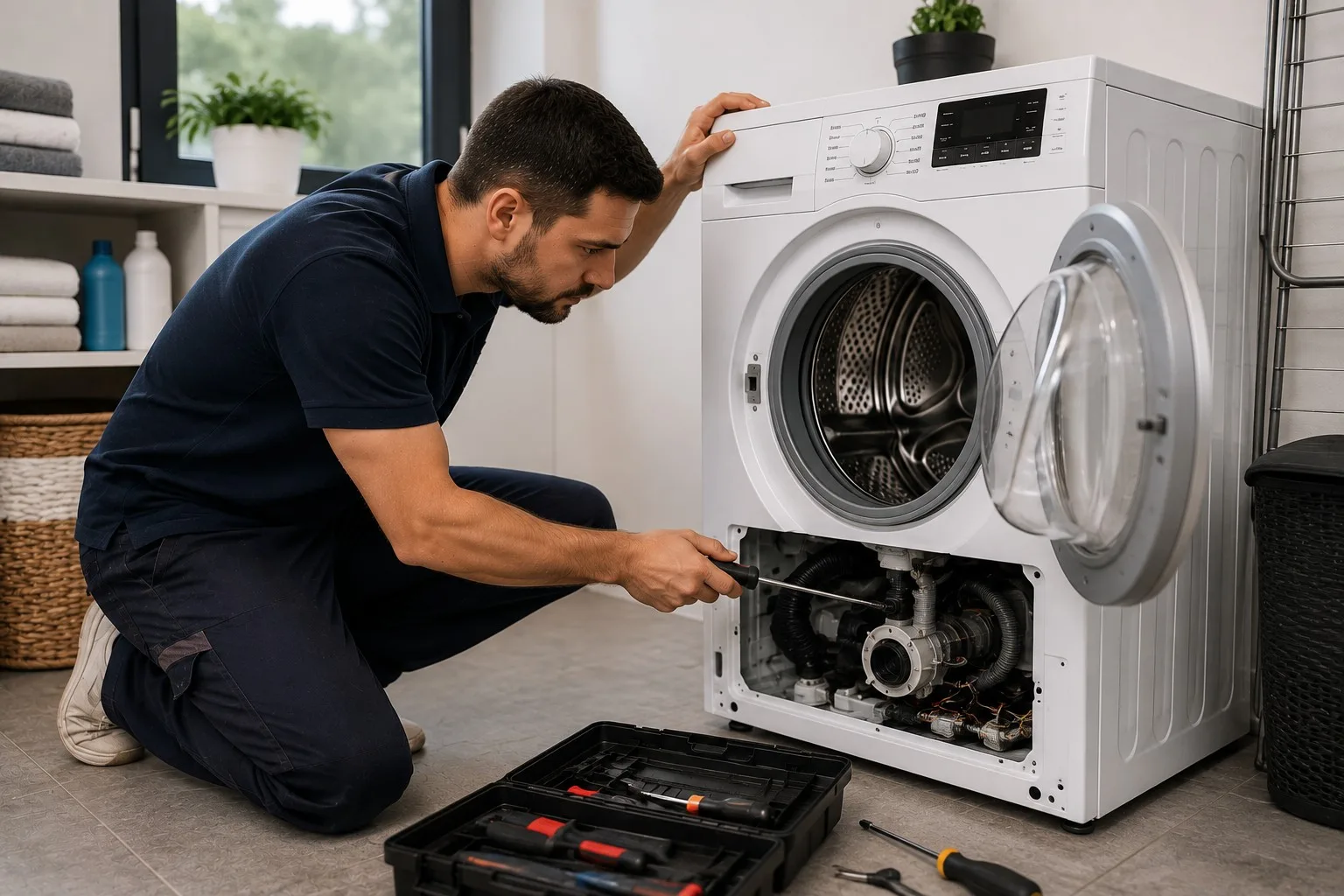
Washer repair in North Carolina covers diagnosis and repair of front-load and top-load washers that will not start, will not drain, will not spin, leak, shake, make loud noises, or show error codes. A local provider visits your home, finds the faulty part — drain pump, lid switch, door seal, belt, or valve — and repairs or replaces it.
Most washer faults announce themselves plainly. The drum fills and then sits full of water. The machine leaks from the front. It shakes across the floor on spin. Each sign points to a small set of parts, and a provider who has seen the same fault many times knows where to look first.
That is how washer repair works here. The provider checks the parts in order — drain filter and hose, pump, lid or door switch, belt, coupling, inlet valves, and door seal — and tests the faulty part, not guesses at it.
What happens during a washer repair visit?
A visit starts with the fault, described in your own words. When did it start? Does the washer fill but not drain? Does it leak only on the spin cycle? Does it make a grinding noise, or no noise at all? Those details narrow the fault before the provider opens the machine.
The provider then runs the machine through a cycle and watches what happens. A washer that fills and drains but never spins usually has a lid switch or drive problem. A washer that will not drain at all usually has a blocked pump filter, a kinked drain hose, or a failed drain pump.
- Describe the fault — what the machine does, and when it started.
- The provider runs a cycle and watches each stage: fill, wash, drain, spin.
- The faulty part is tested with a meter or by hand.
- The repair is explained before any work starts.
- A final full cycle checks the repair holds.
Why won't my washer drain?
A washer that will not drain is the most common washer problem our providers see. The drum sits full of water, and the door on a front-load machine will not open. In most cases the cause is a filter clogged with debris, a hose pinched behind the machine, or a pump that has stopped working.
The pump filter catches coins, hair, lint, and small objects before they reach the pump. When it clogs, the water has nowhere to go. A kinked drain hose does the same thing. If the filter and hose are clear and the washer still will not drain, the pump itself is tested.
Why won't my washer spin?
A washer that fills and drains but will not spin usually has a lid switch fault, a worn drive belt, or a broken motor coupling. The lid switch tells the machine the lid is closed; if it does not engage, the machine will not spin for safety.
A drive belt that has stretched or snapped cannot turn the drum. A motor coupling that has sheared leaves the motor running with no drum movement. An unbalanced load can also stop the spin — a single heavy item bunched on one side throws the drum off balance, and the machine stops to protect itself.
Why is my washer leaking?
Where the water appears tells the provider where to look. A leak from the front of a front-load washer usually means the door seal or gasket has torn or trapped debris. A leak from underneath usually means the drain pump, a hose connection, or the tub seal.
A leak from the back usually means a supply hose or the inlet valve. Supply hoses age, bulge, and eventually split, and a split hose can release a large amount of water quickly. Hoses should be checked whenever the machine is moved.
Why won't my washer switch cycles?
A washer that will not switch cycles usually has a timer or control board fault. The timer moves the machine from one stage to the next — fill, wash, drain, spin — and when it sticks, the machine stays in one stage. A control board fault does the same thing on electronic machines.
The symptom is a machine that washes for far too long, or never moves on to the rinse, or sits on one setting while the dial or display does not advance. A timer that clicks but does not advance points to the timer or the board.
How is a stuck item removed from a washer?
A sock, a coin, or a small item can slip between the drum and the tub, and then the machine grinds, rattles, or stops draining. The item sits where fingers cannot reach it, and forcing the drum to turn can push it further in or damage the tub.
The provider finds the item by turning the drum slowly by hand. On a front-load machine the item is often caught at the door seal, and it can be lifted out once the seal is eased back. On a top-load machine it may sit under the agitator, which comes off for access.
What affects the cost of a washer repair?
Several things decide what a washer repair costs. The part is the biggest factor — a lid switch and a drain pump are different jobs from a drum bearing or a control board. The age and type of the machine matter too: older machines can need parts that are harder to find.
Before any work starts, the provider sets out what the repair involves and whether it is worth doing for a machine of this age. A ten-year-old machine with a failed control board is a different decision from a three-year-old machine with a failed lid switch.
Homeowners across the state can read more about washer repair in North Carolina — that service runs in Monroe, NC, where local providers cover the faults described on this page.