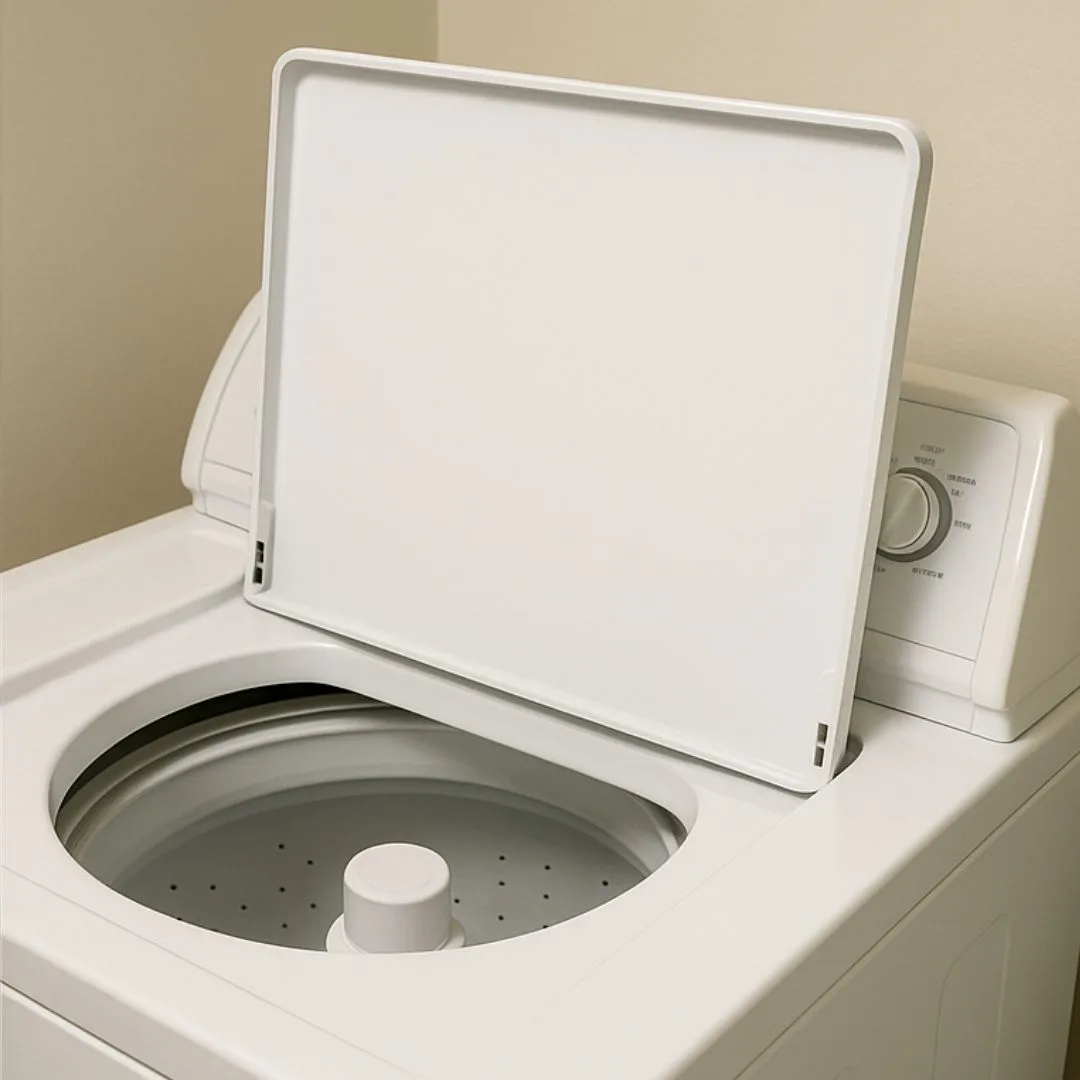
Top-load washer repair covers agitator faults, lid-switch faults, banging and grinding noises, off-balance shaking, drum faults, and drain issues. The provider fixes the faulty part at your home, with parts matched to the make and model and the spin tested before the visit ends.
Top-load washers are the machines most North Carolina homes grew up with: load from the top, agitator in the middle, lid on top. They are simple, sturdy machines, and their faults are usually simple too — a switch, a belt, a coupling, or the agitator itself.
The lid switch is the part top-load owners meet most often. The machine will not spin unless the lid is closed, and the switch is what tells the machine the lid is closed. Behind it sit the agitator, the drive belt, the motor coupling, and the suspension.
Why won't my top-load washer agitate?
The agitator is the finned post in the middle of the drum. It turns one way and then the other, moving the clothes through the water. When it stops turning, the clothes sit still and come out dirty.
An agitator that will not turn usually has worn agitator dogs — the small plastic cogs inside the agitator that let it ratchet in one direction. When they wear, the agitator spins freely both ways and does no work. Replacing the dogs is a small, common repair.
Why won't my top-load washer spin?
The lid switch is a small safety switch under the lid. When the lid closes, the switch engages and the machine is allowed to spin. When the switch fails, the machine will not spin — even though it fills, washes, and drains normally.
- Describe the fault — does the machine stop before the spin, or never spin?
- The lid switch is tested with a meter.
- The drive belt and motor coupling are checked next.
- The faulty part is replaced.
- Run a full cycle to confirm the spin holds.
A lid-switch fault shows up as a machine that stops before the spin, or a machine that will not spin at all. The switch is tested with a meter, and if it has failed it is replaced. It is one of the most common top-load repairs.
Some owners work around a failed lid switch by holding it down or bypassing it. That is not safe — the switch exists because a spinning drum with an open lid can injure a hand. A failed switch should be replaced, not bypassed.
Why is my top-load washer banging and grinding?
A top-load washer that bangs on spin is usually unbalanced, or the load is bunched on one side of the drum. Redistributing the load and running the spin again often clears it. If the machine still bangs with a balanced load, the suspension rods are the likely cause.
Grinding as the drum speeds up points to wear in the drive — the motor coupling, the clutch, or the transmission. A grinding noise during agitation usually means the agitator dogs or the transmission. The provider listens to when the noise happens, because the timing points to the part.
Is the drum off track?
A drum that has slipped off track sits crooked in the cabinet, rubs against the side, and bangs even with a balanced load. The tub has moved on its suspension, or a suspension rod has come loose, and the drum no longer spins true.
The provider reseats the tub on its suspension, replaces any rod that has worn or come loose, and checks the drum turns freely by hand before running a cycle. A drum left off track wears the suspension and the cabinet.
Why does my top-load washer bounce on spin?
Bouncing on spin is the drum moving too far as it speeds up. A top-load drum spins upright, so an unbalanced load throws it sideways with each turn, and the machine bounces and walks across the floor.
The first checks are levelling and load balance. The feet are adjusted, and heavy single items — a blanket, a rug, a load of towels bunched on one side — are spread around the drum with lighter items.
If the machine still bounces with a balanced load on a level floor, the suspension rods or dampers have worn. They carry the drum and let it move a little as it spins; when they wear, the drum moves too much. Replacing the rods makes the machine run quietly again.
Why won't my top-load washer drain?
A top-load washer that will not drain usually has a filter full of coins and lint, a drain hose kinked at the back, or a pump that has worn out. The filter sits before the pump and traps coins, hair, and lint; once it is full, water cannot pass through to the pump at all.
On a top-load machine the pump is driven by the motor, so the provider listens for whether the motor runs while the water stays put. A pump that runs without moving water is worn out and is replaced.
What affects the cost of a top-load repair?
The part decides most of it. A lid switch and agitator dogs are small jobs; a belt and coupling sit in the middle; a transmission is the big one. A fifteen-year-old machine facing a transmission repair is weighed differently from a five-year-old machine needing a lid switch.
Parts for top-load machines are usually easy to find, because the design has changed little over the years and the same parts fit many models. If a part must be ordered, the provider says so, and the work is agreed before anything starts.
For a top-load machine in an older home, see top-load washer repair in North Carolina — those repairs reach Lexington, NC, where providers work on the top-loaders common in mill-era houses.