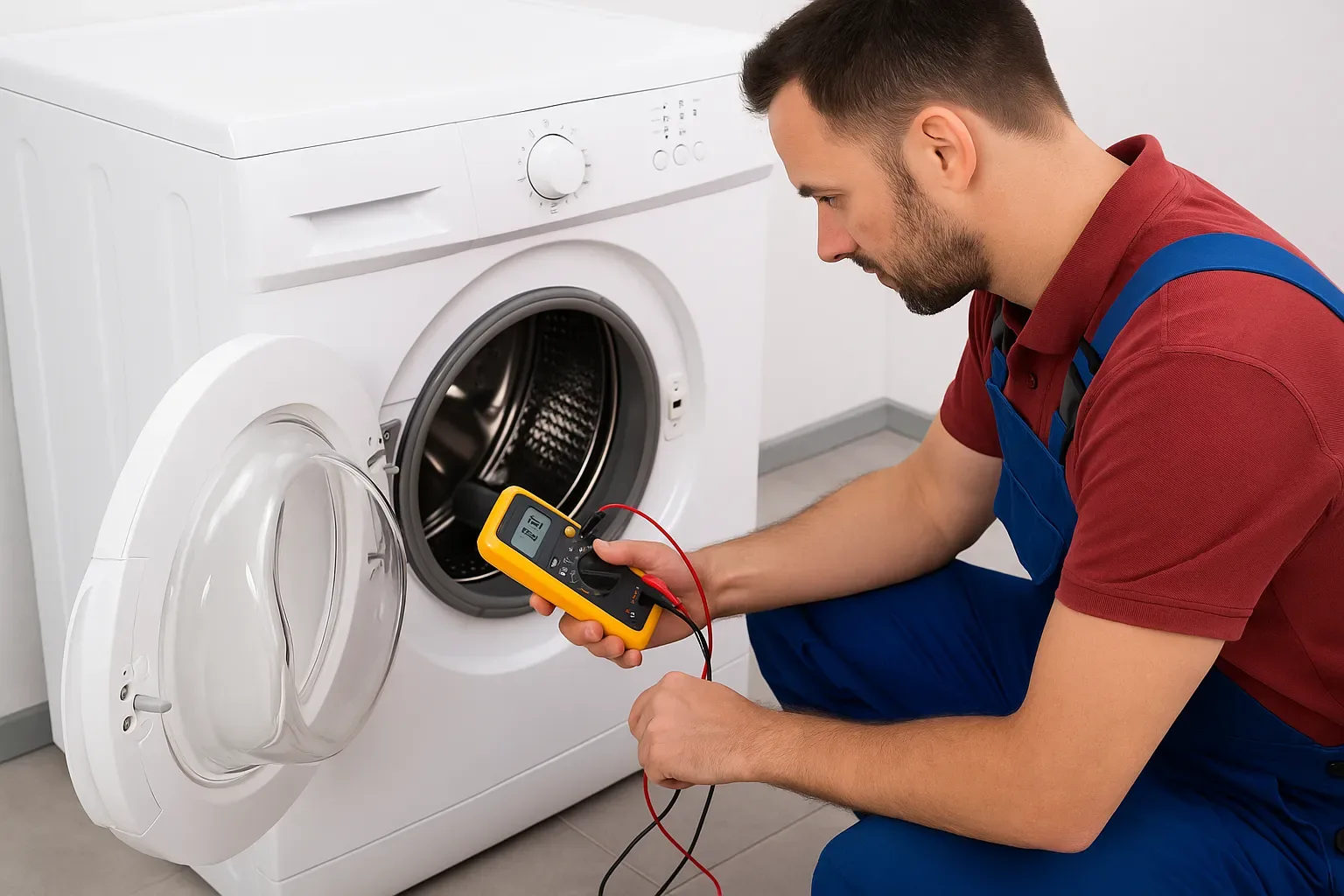
The cost of a washer repair depends mainly on the part that failed, the age and type of the machine, how easy the machine is to reach and work on, and the brand. A small part that is easy to reach costs far less to fix than a major part buried deep inside an older machine, and a repair that needs a part ordered in takes longer than one fixed with a part already on hand.
Every homeowner who calls about a washer repair asks the same question first: what will it cost? It is a fair question, and the honest answer is that it depends — because no two washer repairs are the same.
A lid switch and a control board are both washer repairs, but they are very different jobs, with different parts, different amounts of work, and different outcomes.
This post explains the factors that decide the cost, so you know what a provider is looking at when they give you a figure, and so you can judge for yourself whether a repair is worth doing.
The factors below are the same ones a repair provider works through when they look at your machine.
Then they look at the job: how easy the machine is to reach, whether the part is on hand or has to be ordered, and how long the work will take.
None of these factors is a secret, and none of them is fixed — they change with every machine.
One thing this post will not do is give you a price list, because a price list for washer repair would be misleading.
The same fault on two machines of the same brand can cost different amounts if one machine is easy to reach and the other is built into a tight laundry closet, or if one part is on the shelf and the other has to be ordered.
What this post gives you instead is the full picture of what goes into the cost, so you can have an informed conversation with a provider.
Which part failed — and why does it matter?
The part is the biggest single factor in the cost of a repair, because parts vary enormously in what they are and what they cost. Small parts — a lid switch, a door lock, a drive belt, a drain pump filter — are simple pieces that take little time to fit.
Larger parts — a drain pump, a motor, a control board, a heating element, or a thermal fuse — are more complex, take longer to fit, and cost more as parts.
The diagnosis matters as much as the part, because the fault is not always the part that looks broken. A machine that will not spin might need a lid switch, or it might need a belt, or it might need a coupling — three different parts, three different jobs.
A good diagnosis finds the actual failed part rather than replacing parts until the machine works, and that is what keeps the cost down. When a provider describes the fault to you, ask them which part has failed and why — a clear answer is a sign the diagnosis is sound.
| Factor | What it changes | What to check |
|---|---|---|
| The part that failed | How long the job takes | Which part failed |
| Age and type of machine | Whether parts are still made | The machine's age |
| Access to the machine | How long the work takes | Whether the back can be reached |
| Brand | How quickly the part is found | Genuine or compatible part |
How do the age and type of the machine affect the cost?
Age changes the calculation in two ways. First, older machines are more likely to need parts that are harder to find, because manufacturers stop making parts for older models. A part that has to be ordered takes longer to arrive, and the wait itself is part of the cost of the job.
Second, an older machine that has already had one major part replaced is more likely to need another one soon, which changes whether a repair is worth doing.
The type of machine matters too. A basic top-load washer is generally simpler inside than a front-load washer with electronic controls, a door lock, and a sealed drum. A machine with more features has more parts that can fail, and those parts are often more complex to reach and replace.
A stacked washer and dryer, or a machine built into a tight space, takes longer to work on because the provider has to move things to reach it.
How easy is the machine to reach?
Access is the factor homeowners most often overlook, and it can change a job considerably. A washer standing in an open laundry room with space around it is quick to work on: the provider can reach the back, the sides, and the front without moving anything.
A washer in a tight laundry closet, a washer stacked under a dryer, or a washer built into cabinetry takes longer, because the provider has to move the machine, or the dryer, or both, before the work can even start.
The location of the machine in the house matters as well. A washer in a basement or a garage is usually easy to reach, but the provider has to carry parts and tools downstairs.
A washer on an upper floor means carrying a heavy machine downstairs if it has to come out, and protecting the floors and stairs on the way. Clearing the space around your washer before a visit is the simplest way to keep a job straightforward.
Does the brand affect the repair cost?
The brand of your washer affects the cost in a practical way: how easy the parts are to get. A washer in a Union County home and one in a Forsyth County home face the same factors, and the brand is one of them.
Common brands with a large presence in the United States — Samsung, Maytag, Whirlpool, LG, GE, Kenmore — have parts that are widely available, and a provider is more likely to have the part on hand or to get it quickly.
Less common brands, or machines that were sold for only a short time, can need parts that have to be ordered, and that takes longer.
Parts availability also affects the repair in another way: whether the part is genuine or a compatible part. Genuine parts are made by the manufacturer for that exact model, and they fit exactly.
Compatible parts are made by other manufacturers to fit a range of models, and they can be a good option for older machines where the genuine part is no longer made.
Does a front-load washer cost more to repair than a top-load washer?
Front-load and top-load washers are built differently, and that difference shows up in the cost of a repair. A front-load washer has a door lock, a rubber door seal, and a sealed drum, and reaching the parts inside usually means taking the front of the machine apart.
A top-load washer has a lid switch and an agitator or an impeller, and many of its parts are reached from the top or the back. Neither type is better or worse — they simply have different parts in different places.
The most common repairs are also different. Front-load washers most often need door seals, door locks, and drain pumps. Top-load washers most often need lid switches, drive belts, and motor couplings.
If you know which type of machine you have, and which of these parts has failed, you already know a lot about what the repair involves.
Should I repair or replace my washer?
At some point every homeowner faces the same decision: repair the machine, or replace it. There is no single right answer, because it depends on the machine, the fault, and the household.
A machine that is a few years old and has a single failed part is usually worth repairing, because the rest of the machine has years of life left.
A machine that is old, has already had major parts replaced, and now needs another major part is a harder call, because the next failure may not be far behind.
The way to think about it is in terms of the machine, not just the repair. Ask the provider what has failed, what else in the machine is wearing out, and how much life the machine has left after this repair. If the machine is otherwise sound, a repair is usually the sensible choice.
- Note the brand, the model, and what the machine does.
- Work out which part has failed and how easy it is to reach.
- Clear the space around the machine before the visit.
- Ask what else is wearing out and how much life is left.
- Then decide whether to repair or replace.