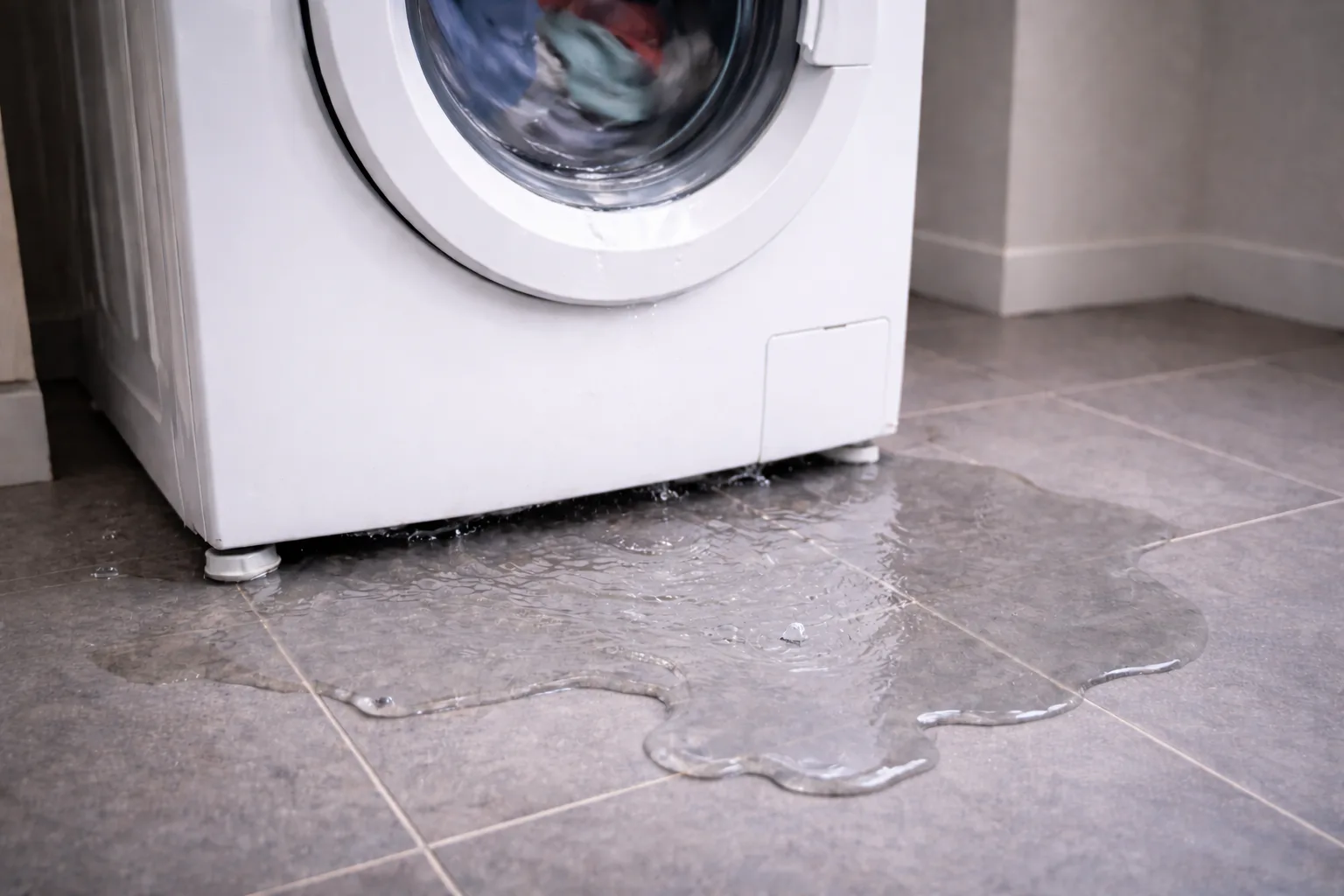
A washer usually leaks because of a worn door seal on a front-load machine, a loose or cracked inlet or drain hose, a failing drain pump, or a detergent drawer that is blocked. Overloading the drum and using too much detergent can also push water out of places it should never reach.
Water on the floor is the one washer problem you cannot ignore, because it does not stay a washer problem for long.
A leak in a second-floor laundry room in a Matthews townhome can stain the ceiling below, while a garage washer in Monroe leaks onto concrete — and a damp patch can soak into flooring, drywall, and anything stored nearby.
In a warm, humid laundry room, dampness that is left alone turns into a musty smell within days, and the damage spreads further than the puddle you can see.
The first step with any leak is to find where the water is coming from, because the source decides the fix.
And water that only appears on some cycles usually means overloading or too much detergent rather than a broken part. This post works through each source in turn.
Start by switching the machine off and unplugging it, and mop up the water on the floor so you can see fresh water as it appears. Never stand in water on the floor while touching a plugged-in machine.
If the leak is heavy and water is spreading fast, turn off the water supply taps behind the machine as well — they are usually on the wall above or beside it — and then work out where the water came from.
How do you find where the water is coming from?
A leak is much easier to fix once you know its source, and finding the source is mostly a matter of watching carefully. Dry the floor completely, then run a short cycle with the machine empty and watch where the water appears first. Water at the front, around the door, points to the seal.
Water at the back, near the wall, points to the inlet hoses or the drain hose. Water underneath the machine points to the pump or an internal hose. Water that appears only during the fill, only during the wash, or only during the spin tells you which part of the cycle is at fault.
The timing matters because different parts are under pressure at different times. A leak that starts the moment the machine fills is usually an inlet hose or the water inlet valve. A leak that appears during the wash is usually the door seal or the detergent drawer.
A leak that shows up during the drain and spin usually comes from the drain pump or its hose.
Could the door seal be leaking?
On a front-load washer, the rubber seal around the door — the door boot gasket — is the most common source of leaks. Samsung, LG, Whirlpool and GE front-load models all use the same kind of rubber seal, and it wears the same way on each.
The seal flexes every time the door opens and closes, and over the years it wears, cracks, and loses its shape. Small objects caught in the fold of the seal, like coins and hair grips, can cut it.
Mould and detergent residue build up in the fold and stop the seal sitting flat against the door, which lets water past it during the wash.
Check the seal by running your finger slowly around the whole fold, feeling for tears, cracks, and anything trapped inside it. Look for black spots and a musty smell, which mean mould has taken hold in the fold.
Wipe the seal dry after each wash and leave the door open between washes so it dries out. A torn or cracked seal cannot be repaired and has to be replaced, and the replacement has to match the exact model, because seals are shaped for one machine.
Fitting a seal is a repair job, not a home fix, because the door has to come apart to reach it.
Are the inlet hoses or their connections leaking?
Two hoses bring water into the machine — hot and cold — and they are under mains pressure the whole time the taps are open, even when the machine is not running. That is why a hose problem can leak when the machine is off, which surprises a lot of homeowners.
The hoses themselves can crack and bulge with age, especially rubber hoses, and the connections at the tap end and at the machine end can work loose over years of vibration.
Look at the hoses where they meet the taps and where they meet the back of the machine. Feel for dampness around the connections, and look for bulges, cracks, or a hose that has gone soft and spongy.
If a connection is loose, you can tighten it gently by hand — never force it with a wrench, because the plastic fittings on the machine crack easily. If a hose is bulged or cracked, turn off the taps and do not use the machine until the hose is replaced.
What if the leak is coming from underneath the machine?
Water underneath the machine usually comes from the drain pump or one of the internal hoses that carry water between the drum, the pump, and the drain. The pump itself can crack, and its seal can wear out. Internal hoses can split where they bend, and their clips can loosen with vibration.
These parts sit inside the machine, so a leak from them only shows up as water on the floor with no obvious source on the outside.
There is no safe home check for an internal leak beyond the one already described — dry the floor, run a short cycle, and see where the water appears.
Opening the machine to look means removing panels and working around wiring and the pump, so this is a repair job. Tell the provider that the water is coming from underneath and when in the cycle it appears, because that narrows the search to the pump or the internal hoses.
Could the detergent drawer or overloading cause a leak?
Not every leak is a broken part. The detergent drawer can overflow if it is blocked with old detergent, and the water it spills runs down the front of the machine and onto the floor, which looks exactly like a door seal leak.
Pull the drawer out and look for a crust of dried detergent in the channels underneath it. Rinse the drawer and the housing it slides into, and the overflow usually stops.
Overloading causes leaks in a different way. A drum packed too full stops water circulating properly, and the wash water can slosh up over the top of the drum and out through gaps it should never reach.
Too much detergent does the same thing by making too many suds — the suds climb up inside the machine and push water out with them.
Both are easy to fix: load the drum loosely enough that you can fit a hand in on top of the clothes, and use the amount of high-efficiency detergent the bottle recommends, not more.
What to do when your washer is leaking
Switch the machine off and unplug it, turn off the water supply taps behind the machine, and mop up the water so you can see where fresh water appears. Check the door seal, the detergent drawer, and the hose connections — the three things you can see and reach safely.
If the leak is from a hose connection, tighten it gently by hand. If it is from the seal, the pump, or underneath the machine, leave it and call a repair provider.
Do not keep running the machine while it is leaking. Every cycle puts more water on the floor, and water that reaches the floor in a laundry room or basement can damage flooring and walls faster than most homeowners expect.
If the leak is heavy, move anything stored on the floor out of the way, put towels down to soak up what is there, and ventilate the room by opening a window or a door.
Then describe the leak to a provider — where the water appears, when in the cycle it appears, and what you have already checked — and let them take it from there.
- Switch the machine off, unplug it, and mop the floor dry.
- Turn off the water supply taps behind the machine.
- Run a short cycle empty and watch where fresh water appears.
- Check the door seal, the detergent drawer, and the hose connections.
- If the leak is from the seal or underneath the machine, leave it and call a provider.