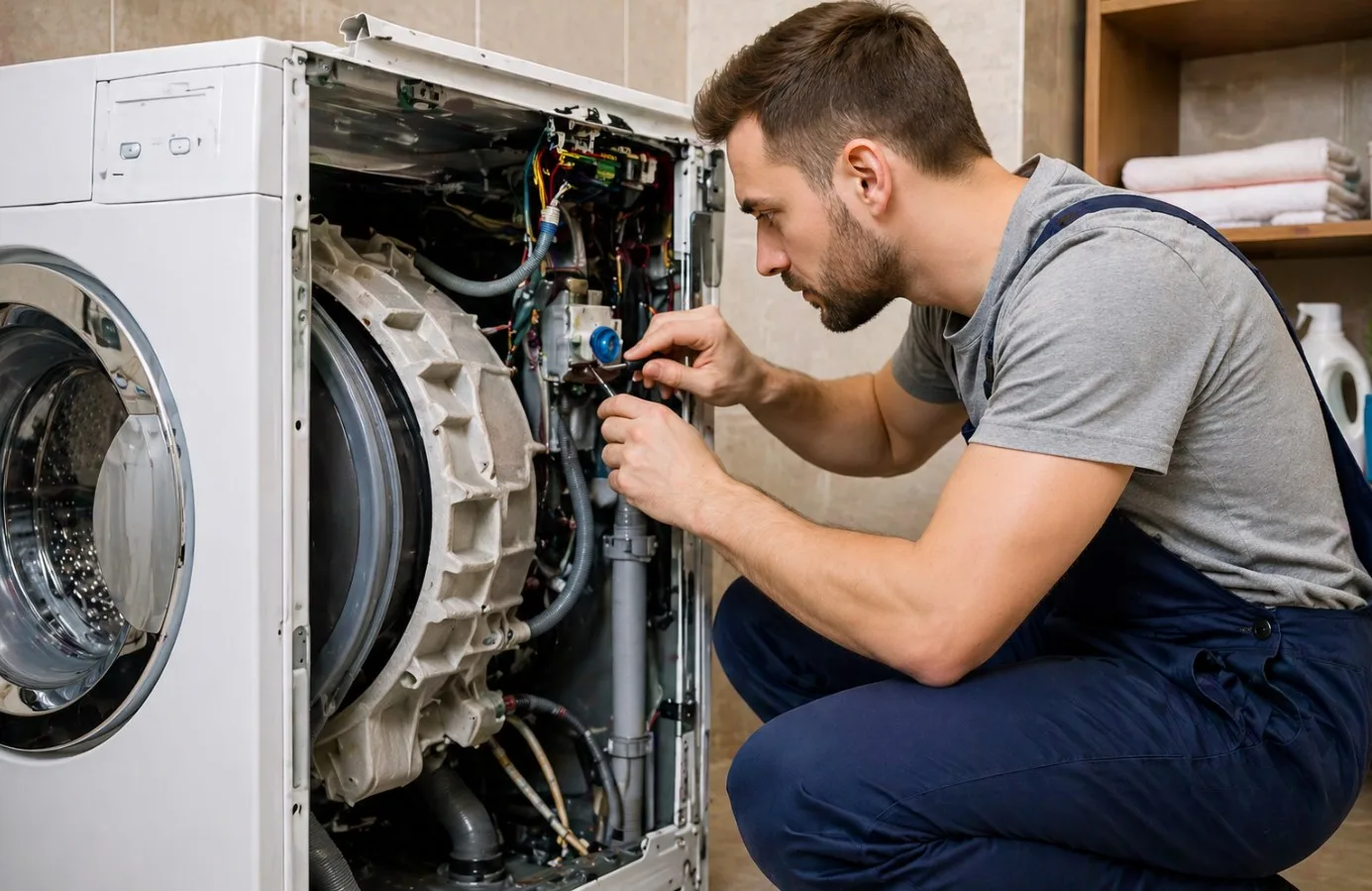
A washer that will not spin usually has a faulty lid switch on a top-load machine or a door lock on a front-load machine, a worn or broken drive belt, a broken motor coupling, or a load that is so unbalanced the machine refuses to spin for its own protection. A machine that will not drain will also not spin, because the spin cycle only starts once the water is out.
The spin cycle is the part of the wash that does the heavy work of getting water out of your clothes, and when it does not happen, you notice it straight away. The cycle ends, you open the door, and the clothes are still dripping wet and heavy.
In a garage in Kernersville or a laundry room in Lexington, the result is the same: dripping clothes and a dryer working overtime, and a dryer that has to work far harder than it should.
A washer that will not spin is usually a safety or a drive problem. The machine either does not know it is safe to spin, or it cannot turn the drum.
And then there is the load itself — a machine that is badly unbalanced will refuse to spin rather than shake itself apart. This post goes through each cause the way a repair provider would, starting with the checks you can do yourself.
One thing to check first, before anything else in this post: is the machine actually failing to spin, or is it failing to drain? A washer will not spin while the drum is still full of water, because the spin cycle only starts after the drain cycle.
If there is standing water in the drum, the problem is a draining problem, and the draining post in this blog covers it step by step.
If the drum is empty of water but the clothes are still wet and the drum never turned, the problem is a spinning problem, and this post is the right one.
What does a washer that will not spin look like?
The signs vary, and they point to different causes. Sometimes the machine finishes the wash and stops, with no spin at all and no sound. Sometimes it tries to spin and you hear the motor running, but the drum does not turn. Sometimes the drum turns slowly, or it starts to spin and then stops.
Sometimes it spins on some cycles but not on others, or it spins with a light load but not with a heavy one.
Listen carefully during the part of the cycle where the spin should happen. A machine that makes no sound at all is usually a switch, a sensor, or a control board problem.
A machine where you can hear the motor running but the drum is still is usually a belt or a coupling problem — the motor is turning, but the power is not reaching the drum.
And a machine that shows an error code tells the provider where to begin looking, so write the code down exactly as it appears.
Is the lid switch or the door lock behind the no-spin fault?
On a top-load washer, the lid switch is the first thing to check. The switch sits under the lid and tells the machine the lid is closed.
The machine will fill and agitate with the lid open, but it will not drain or spin until the switch is engaged, because a drum turning with the lid open is dangerous. If the switch has failed, or it feels loose or worn, the machine may do everything except spin.
You can test it safely with the machine switched off. Open the lid and look for the small switch or the tab that presses it, usually near the hinge or the front edge. Press it gently with a finger and listen for a click — a healthy switch clicks cleanly.
If there is no click, or the switch feels loose, it is likely worn out.
Is the drive belt worn or broken?
On many top-load washers, and on some front-load and compact washers, a rubber belt connects the motor to the drum. Samsung, Maytag and Whirlpool top-load washers all use a rubber drive belt in the same way. The belt turns the drum, and over years of use it stretches, cracks, and wears thin.
A stretched belt slips, so the drum turns slowly or not at all, and you may hear a squealing or a burning rubber smell. A belt that has snapped will leave the drum completely still while the motor runs.
A worn belt often gives warning signs before it fails. The spin gets weaker over several washes, the drum takes longer to get up to speed, or the machine struggles more with heavy loads than with light ones.
A belt is a wear part, like a car tyre — it is meant to be replaced when it wears out, and the replacement has to be the right size and type for the exact model.
Fitting it means opening the machine and working around the motor and the drum, so it is a repair job rather than a home fix, but it is usually a straightforward one once the machine is open.
Has the motor coupling broken?
On many top-load washers, a small plastic and rubber part called the motor coupling connects the motor to the transmission.
Its job is to transfer power from the motor to the drum, and it is designed to break before the motor or the transmission does — it is a sacrificial part that protects the expensive parts.
When it breaks, the motor runs but the drum does not move, and the washer will fill and agitate but not spin.
A broken coupling has a very specific symptom: the machine washes normally, the motor sounds normal during the spin, but the drum stays still. It often breaks suddenly, after an overloaded wash or a wash with something heavy like a rug or a duvet that threw the load off balance.
The part itself is small, but reaching it means taking the machine apart to get to the motor, so it is a repair job.
Is the load unbalanced?
Sometimes the machine is fine and the load is the problem. A washer that senses its load is badly unbalanced will refuse to spin, or will try to spin, shake hard, and then stop.
This is deliberate — a heavy, unbalanced drum spinning at full speed can walk across the floor, damage the machine, and in a laundry room or garage it can pull hoses loose.
Heavy single items are the usual cause: a single heavy towel, a rug, a duvet, or a load that is all on one side of the drum.
This is the easiest cause to fix yourself. Switch the machine off, open the lid or door, and redistribute the clothes evenly around the drum. Take out a heavy item if there is only one, or add a couple of towels to balance a single heavy piece.
Close the lid or door and run a spin cycle with the machine empty of water first, then with the load. If the machine spins normally with a balanced load, the machine is fine and the load was the problem.
If it still will not spin with a light, balanced load, the cause is a part, not the load.
What to do when your washer will not spin
Start with the simple checks: redistribute the load and try a spin cycle, then check the lid switch or door lock for a clean click.
If the drum is full of water, deal with the draining problem first — bail the water out with a jug, check the drain pump filter, and look at the drain hose.
Do not keep running spin cycles on a machine that will not spin, because each failed attempt puts strain on the motor and the belt.
If the load is balanced, the water is out, and the machine still will not spin, listen to what it does during the spin part of the cycle. A silent machine points to a switch or a control problem.
A machine where the motor runs but the drum stays still points to a belt or a coupling. Write down what you hear and whether there is an error code — that description is what a repair provider needs to arrive with the right part.
- Check whether the drum still holds water — drain it first if it does.
- Redistribute the load evenly and try a spin cycle.
- Press the lid switch or door lock gently and listen for a clean click.
- Listen during the spin: a silent machine and a running motor point to different faults.
- Write down what you hear and any error code, then call a provider.