A washer shakes because it is not level, because the load inside the drum is uneven, or because the suspension rods or dampers that hold the drum steady have worn out. A weak or uneven floor can make the shaking worse, and a machine that has never been levelled properly will shake from the first wash.
Every washer moves a little during the spin cycle — that is normal. The drum spins fast, and a small amount of vibration is part of how the machine works.
But when the shaking is strong enough to rattle the walls, when the machine walks across the floor, or when it bangs loudly enough to hear from another room, something is wrong.
On a wood floor in a Cornelius laundry room the shaking sounds louder than on the concrete floor of a Harrisburg garage, and in either place a shaking washer can pull hoses loose, damage the floor, and wear out parts inside the machine far faster than normal use would.
Shaking has a small number of causes, and they are easy to tell apart once you know what to look for. Levelling and load problems are the most common, and both are things you can fix yourself in a few minutes. Worn suspension parts take longer to show up, and they need a repair.
This post works through each cause in order, starting with the two you can check right now.
Before you start checking, one warning: never stand next to a machine that is shaking violently during the spin cycle, and never try to hold it still with your hands or your body.
A drum spinning at full speed carries a lot of force, and a machine that is walking across the floor can trap a hand or a foot. Switch the machine off, let the drum stop completely, and then check the levelling and the load with the machine still and unplugged.
How much shaking is normal?
A healthy washer vibrates a little during the spin, especially as the drum gets up to speed, and then settles into a steady hum. You should be able to put a hand on the top of the machine during the spin and feel a light vibration, not a violent shaking.
The machine should stay where it is. If you can hear the machine from another room, if it moves even a few inches during a cycle, or if it bangs against the wall, the shaking is beyond normal and something needs attention.
The spin speed matters too. A machine on a fast spin shakes more than the same machine on a slow spin, so a machine that only shakes on the fastest setting may just need a slower spin for heavy loads.
Note when the shaking happens — only on spin, only with heavy loads, or all the time — because that tells you whether the cause is the load, the levelling, or a worn part inside the machine.
Is the washer level?
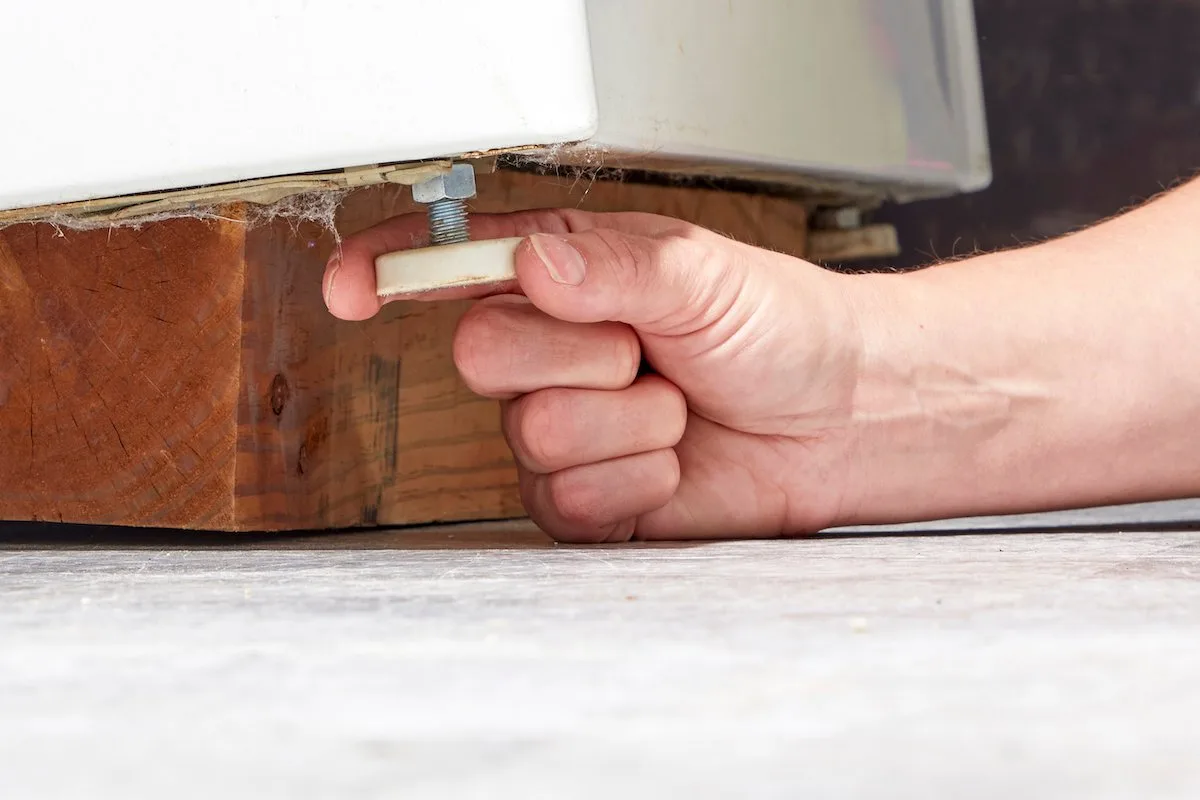
A washer that is not level will shake, because the drum is spinning off-centre. The machine has adjustable feet, usually at the front, and over time they work loose, or the floor settles, or the machine is moved and never levelled again.
A machine that was never levelled properly when it was installed will shake from the very first wash.
Checking it is simple. Put a spirit level on top of the machine, first from side to side and then from front to back. If the bubble is off centre, adjust the feet — turn them to raise or lower each corner — until the bubble sits in the middle both ways.
Then push the top of the machine firmly from side to side and from front to back: it should feel solid, with no rocking.
Is the load uneven?
The most common cause of sudden shaking is a load that is uneven. A single heavy item — a towel, a rug, a duvet, a pair of jeans — can sit on one side of the drum and throw the whole spin off balance.
The drum wobbles, the machine shakes, and the machine may stop the spin altogether to protect itself. This often happens suddenly, on a wash that was fine the time before, because the load is different every time.
The fix is to redistribute the load. Switch the machine off, let the drum stop, open the lid or door, and spread the clothes out so the drum is even all round. Take out one heavy piece, or add a few towels to even it out.
Wash heavy items with other heavy items rather than on their own, and do not overload the drum — a drum packed too full cannot distribute the load at all, and the clothes stay in one heavy lump.
If the machine spins smoothly with a balanced, moderate load, the shaking came from the load, not the machine.
Have the suspension rods or dampers worn out?
Inside the machine, the drum hangs from suspension rods or sits on dampers — springs and shock absorbers that hold the drum steady while it spins. Front-load washers from Samsung and LG and top-load washers from Maytag and Whirlpool all hang the drum on suspension rods or dampers in the same way.
Their job is to soak up the movement of the drum so the machine itself stays still. Over years of use they wear out: the rods stretch, the dampers lose their resistance, and the drum starts to move more than it should.
A machine with worn suspension shakes more and more over months, and the shaking gets worse with heavy loads.
There are a few signs that point to the suspension rather than the load or the levelling. The machine shakes even with a light, balanced load. It shakes more on every wash than it did a few months ago.
You can push the drum by hand and it moves too freely, or it bounces and keeps moving after you let go. And the machine may bang loudly during the spin even when the load is even.
Suspension parts are a repair job — reaching them means opening the machine — but they are a common repair, and replacing them restores the machine to how it should feel.
Could the floor underneath the machine be the problem?
The floor matters as much as the machine. A washer on a solid concrete floor shakes far less than the same washer on a wood floor, because concrete does not flex and wood does.
A wood floor that flexes under the machine will amplify the vibration, and the machine will shake more on that floor than it would anywhere else. A pedestal, a stand, or a stacked dryer above the machine can make it worse, because it raises the machine and gives the vibration more room to move.
If the machine is level, the load is balanced, and it still shakes, look at the floor. Stand next to the machine during a spin and feel whether the floor itself is moving.
If the floor flexes, a rubber anti-vibration mat under the machine can help — it absorbs some of the movement and stops the machine walking. Make sure the machine sits flat on the mat and the mat sits flat on the floor.
What should you do about a shaking washer?
Work through the causes in order: level the machine with a spirit level, then redistribute the load and run a spin with a balanced, moderate load.
If the shaking stops, the problem was the levelling or the load, and you are done — but check the levelling again in a few weeks, because feet work loose and floors settle. If the shaking continues with a level machine and a balanced load, the fault is probably in the suspension.
Do not ignore a shaking washer and hope it settles down. Shaking that continues puts strain on everything in the machine — the drum, the bearings, the hoses, and the motor — and a machine that walks across the floor can pull a hose loose and flood the room.
If the machine shakes violently, switch it off and do not run it again until the cause is found. Tell a repair provider what the machine does, when it shakes, and what you have already checked, and they will know whether to bring suspension parts or just to level the machine properly.
- Switch the machine off and let the drum stop completely.
- Check the levelling with a spirit level, side to side and front to back.
- Redistribute the load evenly and run a spin with a moderate load.
- Push the drum by hand — if it moves too freely, the suspension may have worn.
- If it still shakes, switch it off and call a repair provider.